PRIIPs · Regulation (EU) 1286/2014 · Delegated Regulation 2017/653
Your KID factory works. Your back-book is another story.
Since July 2026 we have scanned 5,800+ live Key Information Documents from 59 manufacturers in eight languages, including 100% of the ETPs listed on the Warsaw Stock Exchange. Current production is largely clean. The failures live in the estate: one major European issuer serves 18.5% of sampled products on the template abolished in 2023, the oldest produced in 2020 and now past six years without review. A leading index manager's public data feed contradicted its own KIDs; four weeks after our note, it was corrected. kidcheck watches everything you have live, before a supervisor, a distributor, or a claimant reads it.
Pilot: five documents drawn from across your range. We choose the sample, so it shows the spread. Full findings within 48 hours. Free.
Findings · from live public documents, July 2026
These documents are on issuers' websites right now.
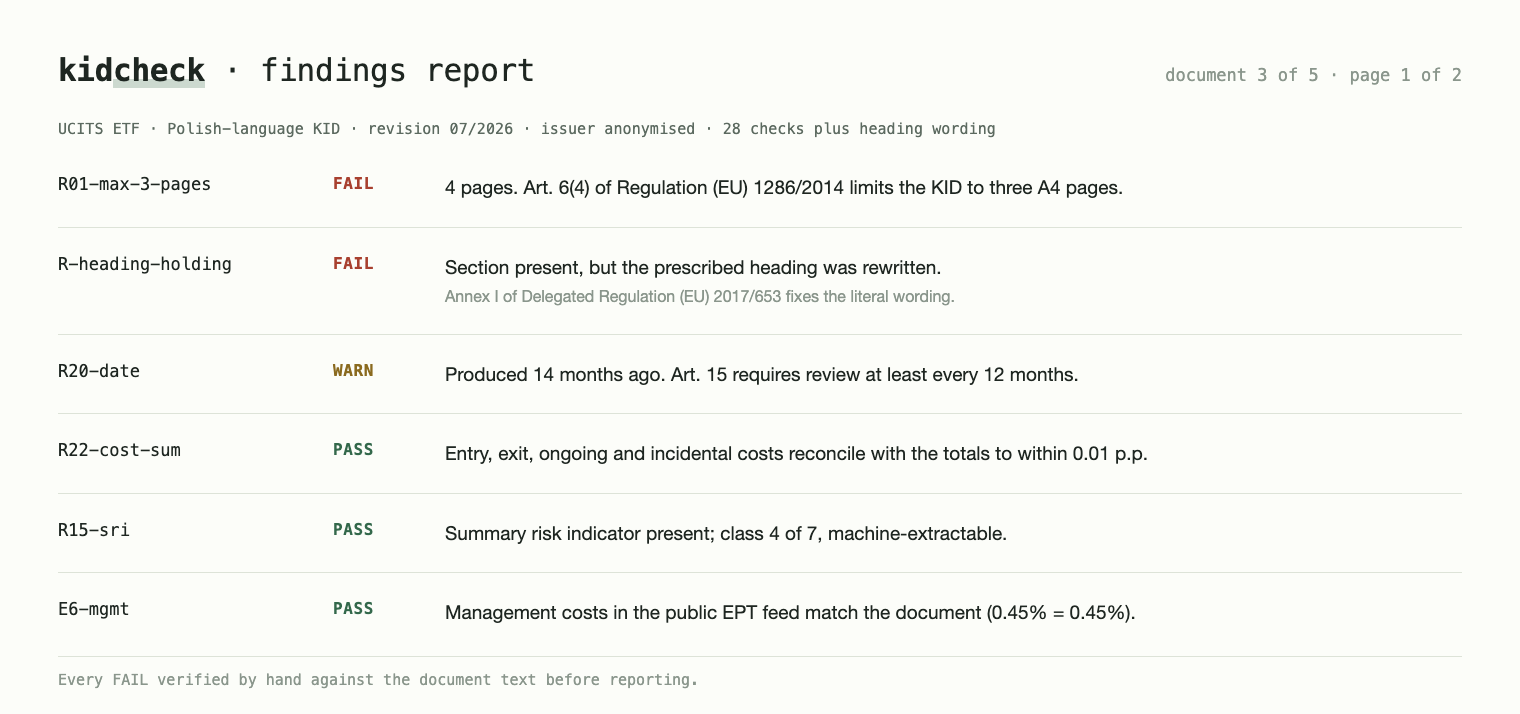
Every finding below was verified by hand against the document text before we counted it. Names available to pilot participants.
A major European structured-products issuer serves KIDs on the pre-2023 template (abolished RIY cost methodology, production dates 2020-2021) for 18.5% of 325 sampled live products. A back-book that was never regenerated. Structured products · 2,549-document population scan · July 2026
A leading index manager's public EPT feed reports management costs of 0.19%; the current KIDs say 0.14%. Every distributor consuming that feed quotes clients stale costs, consistently, in four languages. UCITS ETFs · PDF vs FinDatEx EPT V2.1 reconciliation
Of twenty products we hold in more than one language version, fourteen disagree with themselves in at least one value: same ISIN, same worked example, a different total cost depending on which language the investor reads. Each document is correct on its own; the inconsistency exists only between them. Twenty products, thirteen from one manufacturer · a demonstration that the class exists, not a market rate
One in ten documents in our first study carried no date newer than twelve months; a flagship retail fund's KID was dated 32 months back. Staleness is the most common failure, and the one nobody is watching. Funds & insurance products · German and Italian manufacturers
Four-page KIDs concentrated in one certificate product line; the prescribed "required by law" statement rewritten across another issuer's programme in two languages. Product-line variants drift where programme-wide checks never look. Structured products · major French and US issuers
Outcomes · responsible disclosure
We notify manufacturers before we publish. Estates get fixed.
Every material finding goes to the manufacturer first, with a correction window before anything is published. More than thirty manufacturers and managers notified so far. Two estates verifiably fixed. Both silently: no reply, just corrected documents.
Public cost feed corrected
A leading index manager's EPT feed quoted 0.19% management costs while its KIDs said 0.14%, consistently, in four languages. Four weeks after our note the feed was regenerated. Every distributor consuming it now quotes the right number.
2018 document withdrawn
A fund-linked pension KID produced in 2018, still served live on the template abolished in 2023. It was the oldest document we had found. Two weeks after our note it was taken down.
Correction windows open now
Further findings, from rewrites of the prescribed headings to abolished-template back-books, are with their manufacturers. Findings stay aggregate and anonymous until each correction window closes; verified fixes are reported here.
Method
Twenty-eight checks, three layers deep, on everything you have live.
Your generation platform's job ended when the document was produced. kidcheck continuously reads what you're actually serving: every live product, the way a supervisor's screening does, then two layers further.
Prescribed form
Mandated headings in the prescribed order and official wording, in English, German, French, Italian, Spanish, Dutch, Polish and Danish. Three-page A4 limit. Comprehension alert. Risk-indicator display, scenario labels, review dates, prohibited disclaimers.
Hardened against real-world PDFs: lost spaces, overprinted bold glyphs, split table rows: the extraction traps that make naive checkers cry wolf. Multi-option products (Article 10, Reg. 2017/653) handled: insurer MOP bundles and per-option documents are recognised, not misread as page-limit breaches.
Numbers that add up
Do entry, exit, ongoing and incidental costs sum to the stated total? Does the annual cost impact reconcile with the figures shown? Conditional exit costs and sub-year holding periods handled, so a flag means a finding, not a false alarm.
The ESAs found inconsistent cost tables in 25% of fund KIDs. We check yours before they do.
PDF vs. EPT
Fifteen reconciliation checks of the published document against the FinDatEx
EPT data feed behind it: 01090_SRI, the holding period, every
cost row, the four performance scenarios, publication dates.
The document your investors read and the data your distributors consume, verified to be the same product.
Who it serves
Built for the people who carry the liability.
Manufacturers
A pre-publication gate for every new KID, and dated evidence for the annual review obligation. Article 11, Reg. 1286/2014 gives investors a direct damages claim for a defective KID. Remediate before the letter arrives.
Distributors & platforms
You host thousands of manufacturers' KIDs and serve them to retail clients. Verify what you publish, reconcile the EPT feeds you consume, and catch the stale ones, like the fee change we found that never reached the feed.
Third-party ManCos
You govern documents for dozens of clients' funds and carry the oversight duty for all of them. One independent control layer across every client shelf, before the board pack goes out; findings your client cannot claim you missed.
Compliance & counsel
A findings report per document, referenced to the Delegated Regulation article each check enforces. Evidence for supervisors, boards, and product-approval committees, in minutes, not billable weeks.
Who runs this
One person reads all of it. Deliberately.

Jakub Such
I have spent twelve years building software for banks and insurers: core systems, where a wrong number in a document is a real problem. My specialty is automating work that used to be manual, and I know this domain from all three sides that matter here: the business, the product, and the engineering.
kidcheck applies that to one narrow job. Every number on this page comes from work I ran and verified myself: the scans, the hand checks, the disclosure notes, the correction-window rechecks.
kidcheck audits documents and does not produce them. The production platforms cannot credibly grade their own output; an independent reader can. That independence is the product.
Questions, scepticism, a shelf to check: hello@kidcheck.eu · LinkedIn
Pilot programme
Scan your estate before someone else does.
Send your ISIN list, or just the fund range, and we draw a sample of five published documents ourselves, the way we sampled 2,549 documents from eight major issuers. We choose the sample deliberately, across languages and vintages, so it shows the spread rather than one lucky document. Full findings, free, confidential. If we find nothing, that's your clean-shelf attestation.